Last updated June 24, 2026
The Complete Guide to Garage Door in Pacific Palisades
A homeowner in Des Moines and a homeowner in Pacific Palisades are not shopping for the same garage door — but most installation guides treat them identically. The reality is that Pacific Palisades sits at the intersection of three demanding conditions: marine layer salt air rolling in off Santa Monica Bay, canyon wind events that can push sustained gusts past 60 mph during Santa Ana conditions, and hillside driveways that put mechanical stress on springs and openers that flatland specs never account for. Get those factors wrong, and a door that looks great on installation day starts failing within 18 months. This guide cuts through the generic advice and addresses what Pacific Palisades homeowners actually need to know.
Quick Answer
A garage door in Pacific Palisades needs to be selected, installed, and maintained with three local conditions in mind: coastal salt-air corrosion, canyon wind loads, and hillside driveway mechanics. Steel doors require marine-grade or galvanized coatings, springs must be tensioned for actual door weight on an incline, and openers should be rated at minimum 1/2 HP — preferably 3/4 HP — for driveways with any significant slope. Generic one-size-fits-all advice from national buying guides will routinely steer you wrong in this specific environment.
Table of Contents
- How Salt Air and the Marine Layer Attack Your Garage Door Hardware
- Wind Load Ratings and Canyon-Adjacent Homes
- Hillside Driveways, Spring Tension, and What Goes Wrong
- Matching Opener Horsepower to Pacific Palisades Conditions
- Carriage-Style Doors: Real Hardware vs. Cosmetic Overlay
- Best Door Materials for the Pacific Palisades Climate
- A Maintenance Schedule Built for This Neighborhood
- Common Mistakes to Avoid
How Salt Air and the Marine Layer Attack Your Garage Door Hardware
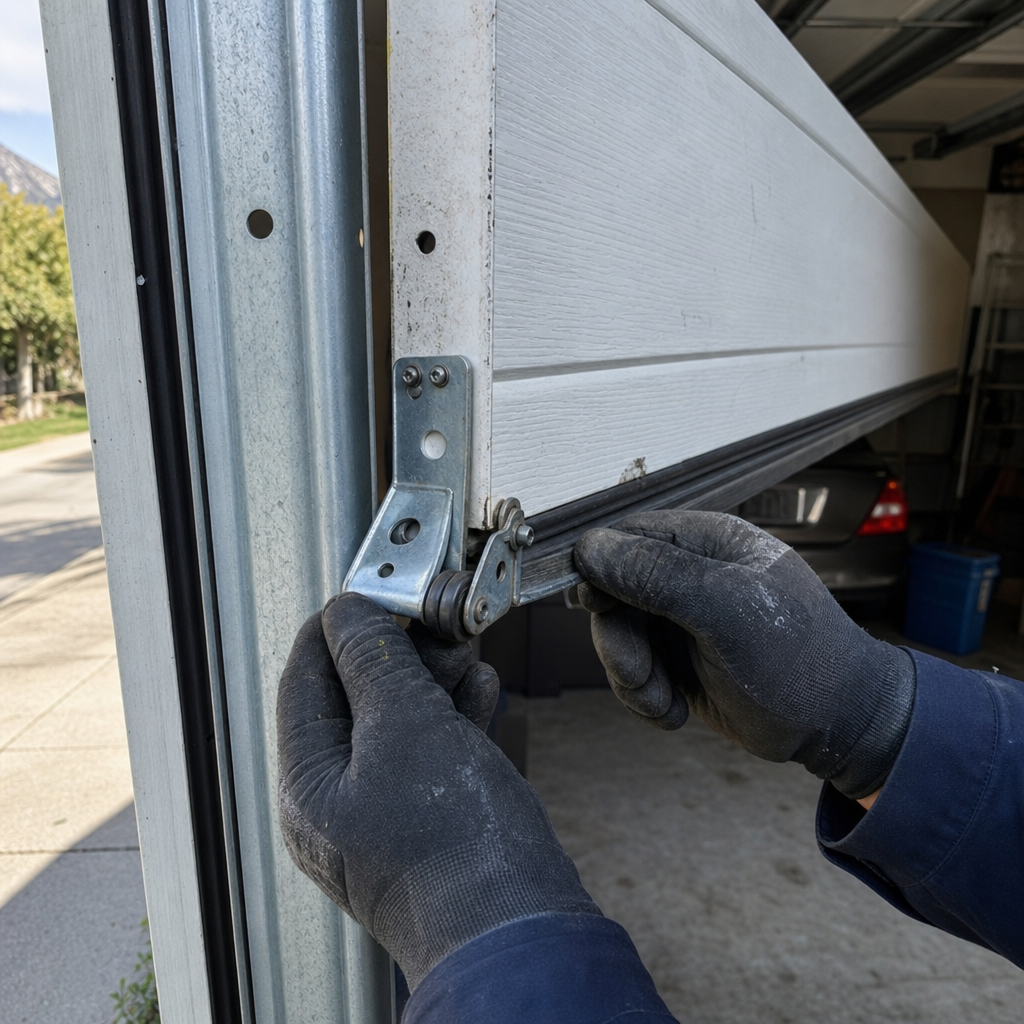
The marine layer that defines Pacific Palisades mornings isn’t just atmospheric — it’s a slow-moving corrosion engine. Salt-laden moisture settles on every exposed metal surface: torsion springs, lift cables, bottom seal retainers, hinges, and roller stems. The damage isn’t always visible until it’s already structural.
Torsion springs are the most vulnerable component. Standard springs use oil-tempered steel wire that oxidizes relatively quickly in coastal environments. In our experience working in Pacific Palisades and the surrounding coastal corridor, spring lifespans that manufacturers rate at 10,000 cycles frequently fall short of that under consistent marine layer exposure — especially on north-facing garages that stay damp longer each morning. The rust doesn’t just discolor the spring; it creates micro-fracture points that cause sudden, unpredictable failure.
Bottom seals take a different kind of hit. The contact zone between a vinyl or rubber seal and a concrete driveway holds moisture, and that moisture carries salt. We regularly see seal degradation in Palisades homes within 3–4 years when the wrong seal material is used. Galvanized or stainless bottom retainers and EPDM rubber seals outperform standard PVC seals significantly in this climate.
Hardware choices that hold up in Pacific Palisades:
- Springs: Galvanized torsion springs — the zinc coating dramatically slows oxidation near the coast
- Cables: Galvanized or stainless steel lift cables over standard bare steel
- Hinges and rollers: 13-ball nylon rollers reduce metal-on-metal contact and don’t corrode
- Bottom seal retainer: Galvanized steel retainer with EPDM rubber seal insert
- Tracks: Galvanized steel tracks — they cost marginally more and outlast standard tracks by years in this zip code
The incremental cost of galvanized hardware over standard is typically $80–$150 on a full installation. The cost of a spring replacement call-out 18 months ahead of schedule is more than that. It’s a straightforward trade.
Wind Load Ratings and Canyon-Adjacent Homes
Pacific Palisades sits directly adjacent to Topanga Canyon, and the topography channels wind in ways that flatland neighborhoods don’t experience. During Santa Ana events, gusts in the Palisades Riviera and Castellammare areas can exceed 60–70 mph. Standard residential garage doors are typically tested to withstand wind pressures of 20–25 psf (pounds per square foot). That’s adequate for most of Los Angeles — but not necessarily for canyon-facing elevations in this neighborhood.
A garage door that fails under wind load doesn’t just mean repair costs. A door that buckles inward creates a pressure event that can compromise the structure of the garage itself, and in attached garages, that pressure transfers to the living space. This is why the 2019 California Building Code, as adopted locally, specifies wind load requirements that vary by exposure category — and homes on exposed hillside lots in Pacific Palisades typically fall into a higher exposure classification than valley homes.
What to look for in a wind-rated door:
- Horizontal struts (typically 14-gauge steel) across each panel section — not just the top panel
- Doors rated to 130 mph wind speed or higher for exposed hillside locations
- End stiles and center stiles that provide vertical rigidity, not just decorative framing
- Heavy-duty track hardware — the track bracket anchors are the first failure point under lateral load
Brands like Clopay, Amarr, and Wayne Dalton all publish wind-load certifications on their product lines. When we spec doors for hillside properties in Pacific Palisades, we reference those certifications specifically — not just the aesthetic catalog.
Hillside Driveways, Spring Tension, and What Goes Wrong
This is the section most installation guides skip entirely, and it’s the one that causes the most callbacks in Pacific Palisades.
Torsion spring systems are calibrated to the weight of the door. The calculation is straightforward on a level driveway: measure the door, calculate the weight, set the spring tension to achieve proper counterbalance. On a hillside property, the driveway slope changes the effective mechanical load on the opener and on the springs during the transition from closed to the first few inches of travel — the point of maximum mechanical resistance.
We’ve seen installers come out to Palisades Highlands properties, measure the door correctly, and then set spring tension using standard flat-driveway tables. The door opens and closes fine during the installation visit. Within six months, the opener motor is straining, the spring is over-cycling, and the homeowner is getting premature component wear across the board. The incline wasn’t accounted for.
What a proper hillside installation accounts for:
- Measure actual door weight, not just panel size — insulated doors and solid wood doors vary significantly
- Document the driveway slope angle and factor it into spring wind count calculations
- Test door balance manually (disconnect the opener, lift by hand to waist height, release) — a balanced door holds position; an unbalanced door drifts up or down
- Verify opener force settings after spring calibration, not before — the opener should be the last line of effort, not compensating for a poorly balanced door
- Re-check balance at 30 days after installation when springs have fully seated
The balance test in step 3 is something any homeowner can do. If your door drifts down when released at mid-point, the springs are under-wound. If it rises, they’re over-wound. Either condition accelerates opener motor wear and shortens spring life.
Matching Opener Horsepower to Pacific Palisades Conditions
The national recommendation for a standard single-car garage door is a 1/2 HP opener. For Pacific Palisades, that’s a starting point, not a ceiling.
When you combine door weight (insulated steel or wood doors commonly run 150–200 lbs), a driveway slope that adds mechanical resistance, and the occasional need for emergency operation during a power outage using battery backup, a 1/2 HP opener is working near its upper limit consistently. That shortens motor life measurably.
Our standard recommendation for most Pacific Palisades residential installations:
- Single-car, lightweight door, flat apron: 1/2 HP is adequate — LiftMaster 8365W or Chamberlain B510 are solid choices
- Single-car, insulated door, sloped driveway: 3/4 HP minimum — LiftMaster 8550W, Genie SilentMax 1200
- Two-car or heavy wood door: 3/4 HP to 1-1/4 HP — LiftMaster 8587W or Raynor’s ProDrive series for heavier applications
- Any hillside property with a wood carriage door: 1-1/4 HP — wood is heavier than it looks and doesn’t get lighter with age
Battery backup is not optional in Pacific Palisades. Wildfire-related power outages have occurred in this neighborhood, and a car trapped behind a non-functioning garage door during an evacuation event is a serious safety concern. LiftMaster and Chamberlain both offer integrated battery backup in their mid-to-upper tier openers. That feature is worth more here than almost anywhere else in Los Angeles.
Carriage-Style Doors: Real Hardware vs. Cosmetic Overlay
Carriage-style doors are enormously popular in Pacific Palisades — they suit the architectural character of the neighborhood’s Craftsman bungalows, Spanish Colonials, and newer Traditional builds. But “carriage style” covers a wide range of actual products, and the difference between them matters structurally and aesthetically.
Overlay carriage panels are standard sectional doors with decorative hardware and surface detailing applied to make them look like swing-out carriage doors. They operate exactly like any other sectional door — on tracks, counterbalanced by torsion springs. The carriage aesthetic is purely cosmetic. These are the most common and most affordable option. Clopay’s Coachman series and Amarr’s Classica line are well-executed examples.
True carriage doors swing outward on hinges and require clear space in front of the garage for operation — which hillside driveways with tight aprons often can’t accommodate. They also require different hardware entirely: no torsion spring system, no track, instead heavy-duty pivot hinges and a surface-mounted latch. They’re authentic but operationally limiting on a tight Pacific Palisades lot.
The trade-off most homeowners don’t know about: real carriage doors can’t use a standard overhead opener. Automated operation requires a specialized side-mount motor system, which adds cost and complexity. For most properties in the Palisades, an overlay sectional door gives 95% of the visual result without the operational constraints. We’re direct about this when homeowners ask — the right answer depends on the specific driveway geometry, not which option looks better in a brochure.
Best Door Materials for the Pacific Palisades Climate
Material selection is where coastal homeowners most often get generic national advice that doesn’t apply here.
Steel (most common): Works well in Pacific Palisades IF it’s specified correctly. 24-gauge steel with a galvanized substrate and a high-quality factory finish — look for polyester or polyurethane topcoat, not vinyl-backed steel. The finish is the barrier between the substrate and salt air. Scratches and chips need prompt touch-up, not eventual attention.
Aluminum: Genuinely corrosion-resistant and appropriate for the coastal environment. Lighter than steel, which helps with opener load and spring life. The trade-off is dent resistance — aluminum dents more easily than steel. For high-traffic garages with tight clearance (common on hillside properties), steel’s dent resistance may be worth the corrosion management.
Wood: Authentic and architecturally appropriate for many Pacific Palisades homes. Also the highest-maintenance option in a coastal environment — wood absorbs moisture, and unprotected end grain swells, warps, and rots. If you choose wood, plan for a refinishing schedule every 3–5 years and use a marine-grade sealer on all exposed surfaces. Wayne Dalton and Clopay both offer wood doors with factory-applied multi-coat finishes that extend the maintenance interval meaningfully.
Fiberglass and composite: Underused and worth more consideration in this climate. Composite doors resist corrosion, don’t warp, and can be manufactured to convincingly replicate wood grain. They’re heavier than aluminum but competitive with steel. Raynor offers composite options that perform well in coastal applications.
A Maintenance Schedule Built for This Neighborhood
The standard annual maintenance schedule promoted in most guides works in Phoenix. In Pacific Palisades, the salt-air environment and seasonal wind events push a more proactive cadence.
Every 6 months (spring and fall):
- Lubricate torsion springs, hinges, rollers, and track curves with a lithium-based spray lubricant — not WD-40, which attracts dust and washes off quickly in humid conditions
- Inspect all visible hardware for surface rust — catch it at the oxidation stage, before it penetrates
- Test door balance manually (disconnect opener, lift to mid-point, release — door should hold position)
- Check bottom seal for cracking, compression set, or salt residue buildup — replace if the seal no longer makes full contact
- Inspect cables for fraying, especially at the drum — this is a failure point that’s easy to miss visually
- Test auto-reverse function: place a 2×4 flat on the ground in the door’s path, close the door — it must reverse on contact
After every significant Santa Ana event:
- Inspect track mounting brackets and lag bolts — wind loading stresses these fasteners and they can loosen without visible indication
- Check panel seams and weatherstripping for debris compression that can interfere with sealing
- Test opener force settings — sustained wind resistance can cause some openers to recalibrate their force limits incorrectly
The fall service call before Santa Ana season is the single highest-value maintenance investment for Pacific Palisades homeowners. What looks like a minor cable issue in October becomes an inoperable door during a November wind event.
Common Mistakes to Avoid
- Installing standard (non-galvanized) springs and assuming they’ll last the rated cycle count. In coastal Pacific Palisades, standard oil-tempered springs regularly fail well before their rated lifespan. Specify galvanized springs from the start — the cost difference is minimal relative to an early replacement call.
- Choosing an opener based on door size alone, ignoring driveway slope. A 1/2 HP opener on a 150-lb insulated door on a 15% slope is working at the edge of its capacity every single cycle. That’s not a safety margin — that’s a slow motor burnout in progress.
- Skipping the wind-load conversation with your installer. If you’re on a hillside or canyon-facing lot in Pacific Palisades and your installer doesn’t mention wind-load ratings, bring it up. The structural reinforcement package on a higher-rated door is not expensive relative to the cost of a blown-out door during a Santa Ana event.
- Choosing real swing-out carriage doors for a tight hillside apron. Authentic carriage doors require clear swing space. On a steep driveway with limited flat apron, they’re operationally impractical. An overlay sectional door gives you the look without the clearance problem.
- Using WD-40 as a garage door lubricant. WD-40 is a solvent and water displacer, not a lasting lubricant. In a humid coastal environment, it evaporates and leaves components dry faster than a proper lithium grease or silicone-based spray. We’ve seen this cause accelerated roller wear and squeaking on doors that were “just lubricated.”
- Ignoring bottom seal deterioration because the door still closes. A failing bottom seal doesn’t just let in drafts — in Pacific Palisades, it’s allowing salt-laden moisture under the door, which corrodes the floor-level hardware and promotes mold in garages that aren’t climate-controlled.
- Hiring a generalist handyman for spring replacement. Torsion springs store significant mechanical energy. Incorrect installation can result in violent spring failure. This is a job for a specialist with the right winding bars and torque knowledge — not a general contractor filling a schedule gap.
When to Call a Professional
Some garage door tasks are reasonable DIY territory: lubricating hardware, testing auto-reverse, cleaning weatherstripping. These are not:
- Any torsion spring work — the stored energy in a wound spring is enough to cause serious injury if mishandled
- Cable replacement — frayed or broken cables are under load and require proper tools and technique
- Door won’t open and a car is trapped inside — this is an emergency scenario, not a weekend project
- Opener behaves erratically after a Santa Ana event — force settings and safety sensors may need recalibration
- New installation on a hillside property — spring tension calculation and track alignment on a slope require hands-on expertise, not a YouTube tutorial
- Any structural damage to panels or tracks after an impact — compromised panels affect wind load integrity
Precision Overhead Door Service Pacific Palisades offers free estimates for Pacific Palisades homeowners — and when the situation is urgent, emergency service is available. Call (866) 650-8772 to speak directly with Steven Moore’s team.
Frequently Asked Questions
A new residential garage door installation in Pacific Palisades typically runs $900–$2,800 depending on door size, material, insulation value, and whether you’re replacing just the door or the full system including opener and hardware. Coastal-spec upgrades — galvanized hardware, marine-grade finishes, wind-load reinforcement — add $150–$400 to a base install but are strongly worth it in this neighborhood. Wood carriage doors at the high end of the market can push $4,000–$6,000 installed. Get a line-item quote so you know exactly what’s included.
Standard torsion springs are rated for approximately 10,000 cycles under ideal conditions. In Pacific Palisades, salt-air corrosion can reduce effective lifespan by 20–30% on non-galvanized springs. With typical residential use (4–6 cycles per day), that translates to a realistic service life of 5–7 years on standard springs vs. 7–10 years on galvanized. Inspect springs every 6 months for surface rust — orange discoloration on the coils is your early warning sign.
Pacific Palisades falls under Los Angeles County and City of Los Angeles jurisdiction depending on the specific address. The California Building Code (CBC) and local amendments govern garage door wind-load requirements, and homes in designated high-wind or fire-hazard zones face stricter specifications. Hillside properties in the Palisades Riviera and Castellammare areas often fall into higher wind-exposure categories. Your installer should pull the relevant permit when required — if they’re not mentioning permits on a new installation, ask why.
For most hillside properties in Pacific Palisades, a belt-drive opener rated at 3/4 HP to 1-1/4 HP with integrated battery backup is the right specification. The LiftMaster 8550W and Genie SilentMax 1200 are strong options in the 3/4 HP range. For heavier doors — solid wood or oversized two-car — the LiftMaster 8587W handles the load reliably. Battery backup is critical in this neighborhood given the history of wildfire-related power outages; it’s not an optional upgrade here.
Yes — and they look excellent on the neighborhood’s architectural character. The key question is whether you want a true swing-out carriage door (which requires clear swing space in front of the garage) or an overlay sectional door with carriage styling. Most Pacific Palisades properties with hillside or tight-apron driveways are better served by an overlay sectional option from manufacturers like Clopay or Amarr, which delivers the same visual result without the operational constraints. For properties with a flat, generous apron, real carriage doors are a viable and beautiful option.
Look for a specialist — not a general contractor who does garage doors among other things. Verify they have direct experience with hillside properties, can speak specifically about coastal hardware specifications (galvanized springs, wind-load ratings), and can name the brands they regularly service. Check their review history for volume and consistency: a company with 80+ reviews averaging 5.0 stars has demonstrated repeatable performance, not just a few good days. Steven Moore at Precision Overhead Door Service has 12 years of exclusive garage door focus and Garage Door Repair in Santa Monica experience across the entire coastal corridor — the conditions here are his specialty, not a footnote.
The Bottom Line
Pacific Palisades is one of the most demanding environments for garage doors in Southern California — the combination of marine layer corrosion, canyon wind loads, and hillside driveway mechanics creates failure modes that generic installation guides never address. The right door for this neighborhood means galvanized hardware, wind-rated panels, properly calculated spring tension for sloped driveways, and an opener with enough horsepower and battery backup to handle real conditions. Maintenance needs to happen twice a year, not once. And when something goes wrong — especially with springs, cables, or a door that won’t open — that’s a job for a specialist.
For homeowners exploring a Garage Door Installation in Santa Monica or the wider coastal area, the same principles apply. And if you’re evaluating Garage Door Opener in Santa Monica options, horsepower and battery backup deserve more attention than most buyers give them.
When you’re ready to talk specifics — whether that’s a new installation, a repair, or just a second opinion on what your current system actually needs — call Precision Overhead Door Service Pacific Palisades at (866) 650-8772 for a free estimate. Steven Moore has 12 years of exclusive garage door experience and 88 five-star reviews behind that number. Those don’t come from guessing.
Written by the team at Precision Overhead Door Service Pacific Palisades, serving Pacific Palisades since 2014.