Last updated June 24, 2026
How to Hire a Garage Door Contractor in Pacific Palisades: A Step-by-Step Guide
The most common scam in the garage door industry starts with a $29 service call advertised online and ends with a $600 invoice for parts that cost $40. It happens everywhere, but it happens more in high-income neighborhoods — and Pacific Palisades is near the top of that list. Operators who run this play know that homeowners here are more likely to approve an inflated quote than argue with a stranger crouching over a broken spring. This guide gives you the exact vetting framework to identify a legitimate contractor before anyone sets foot in your garage: the right phone questions, the license verification steps, the estimate red flags, and the warranty language that separates professionals from predators.
Quick Answer
To hire a qualified garage door contractor in Pacific Palisades, verify their California Contractor’s License number through the CSLB database, confirm who will physically be on the job site, and get a written estimate that itemizes parts, labor, and any service fee separately before work begins. Avoid any contractor who quotes only a labor rate without specifying parts costs, or who cannot name a license number on the spot.
Table of Contents
- Why Pacific Palisades Attracts Predatory Garage Door Contractors
- The Phone Questions That Separate Real Contractors from Call Centers
- How to Verify a California Contractor’s License (And Why a Business License Isn’t Enough)
- What a Legitimate Written Estimate Looks Like — And Three Line Items Scammers Hide
- Why ‘Same-Day’ Guarantees Are Often a Warning Sign, Not a Green Flag
- What Warranty Language Should Actually Say
- Step-by-Step: How to Hire a Garage Door Contractor in Pacific Palisades
- Common Mistakes to Avoid
- When to Call a Professional
- Frequently Asked Questions
- The Bottom Line
Why Pacific Palisades Attracts Predatory Garage Door Contractors
Pacific Palisades sits in one of the most economically concentrated zip codes in Los Angeles County. That fact is not lost on low-quality contractors who farm leads through national aggregator sites and price-bait ads. The model is straightforward: advertise a $29 or $49 service call, dispatch a technician with minimal training, and use the on-site moment — when the homeowner’s car is trapped and their schedule is already disrupted — to push inflated repair quotes.
The geography adds another layer of complexity. Pacific Palisades homes are often built on hillside lots or in canyon-adjacent terrain where salt air from the ocean accelerates metal corrosion on springs, cables, and tracks. A technician who doesn’t understand coastal California hardware degradation will misdiagnose the actual failure and replace the wrong components. We’ve seen torsion springs on homes along Sunset Boulevard that failed in under four years because the wrong cycle-rated spring was installed for a coastal environment — not because the door was used heavily.
This environment rewards contractors who specialize and punishes homeowners who default to whoever ranks highest in a paid ad slot. Knowing how to vet before you book is the only protection that consistently works.
The Phone Questions That Separate Real Contractors from Call Centers
The single most important question you can ask before booking is: “Who will physically be doing the work at my house?” The answer to that question tells you more than any review summary.
A legitimate owner-operator or small specialist will answer directly — they’ll name the technician, or tell you it’s the owner. A national call-center dispatch model will give you language like “one of our certified technicians” or “a local pro in your area.” That phrasing means they don’t know yet, which means you don’t know either. The person who shows up could be a W-2 employee with six months of experience or a day-labor subcontractor with no accountability to the brand name you called.
Here are the specific questions worth asking over the phone before booking:
- “Will the same person who diagnoses the problem also be doing the repair?” — Separated diagnosis and repair appointments are sometimes used to double-bill.
- “Can you give me your California Contractor’s License number right now?” — A legitimate contractor knows this number by heart. Hesitation is a red flag.
- “Do you carry your own liability insurance, or does coverage go through a parent company?” — If anything goes wrong in your home, you need to know whose policy responds.
- “Is your service fee credited toward the repair if I approve the work?” — Many predatory operators charge $49 to show up, then charge full labor on top of it without disclosing that upfront.
- “What brands do you regularly work on?” — A specialist should name brands confidently. Vague answers like “all brands” without specifics suggest limited actual experience.
At Precision Overhead Door Service Pacific Palisades, owner Steven Moore typically takes these calls personally. When you ask who’s coming, the answer is straightforward — because Steven is usually the one showing up.
How to Verify a California Contractor’s License (And Why a Business License Isn’t Enough)
This is the step most homeowners skip, and it’s the one that costs them the most. A California business license and a California Contractor’s License are entirely different documents issued by entirely different government bodies. A business license means someone registered with the city or county to operate. A Contractor’s License — issued by the California Contractors State License Board (CSLB) — means the individual has passed a trade exam, carries a surety bond, and maintains proof of liability insurance.
Any contractor doing repair or installation work on your property that exceeds $500 in combined labor and materials is legally required to hold a valid CSLB license. That threshold is easy to hit in garage door work — a single torsion spring replacement with labor typically runs $150–$350 in the Pacific Palisades market, and a full opener installation with a new Clopay or Wayne Dalton door can reach $1,200–$3,500.
Here’s how to verify in under two minutes:
- Go to cslb.ca.gov and click “Check a License.”
- Enter the contractor’s name or license number.
- Confirm the license is Active — not expired, suspended, or in disciplinary status.
- Confirm the license classification covers the work being done. For garage door work, look for a C-61/D28 (Door, Gate and Activating Device) or a general B license.
- Check the bond and workers’ compensation status — both should show as current.
If a contractor resists giving you a license number or says “we’re working on getting licensed,” stop the conversation. In California, unlicensed contractor work voids your homeowner’s insurance coverage for that repair in most cases.
What a Legitimate Written Estimate Looks Like — And Three Line Items Scammers Hide
A legitimate estimate isn’t a verbal quote given at the curb. It’s a written document — even a digital one sent to your email — that breaks out the job into its components before any work starts. Here’s what it must contain:
- Parts cost, itemized by part: Spring type and cycle rating, cable gauge, rollers, opener model number if applicable. Not “parts: $TBD.”
- Labor cost, stated separately: How much is the technician’s time, distinct from the parts cost.
- Service or diagnostic fee: Stated upfront, and clarified whether it applies toward the total if you approve the work.
- Brand and model of any major component being installed: If they’re putting in an opener, it should say LiftMaster Model 8500W or Chamberlain B2405 — not “1/2 HP opener.”
The three line items that disappear in scam quotes until the technician is already on-site:
- Spring disposal or “hazardous material” fees: Old springs are steel — they go in a recycling bin. A $75–$150 “disposal fee” that appears after diagnosis is fabricated.
- Cable or drum replacement “required” alongside spring work: Sometimes cables do need replacement when springs are replaced — but this should be disclosed in the estimate, not added verbally once the door is disassembled.
- Programming or “setup” fees for openers: Legitimate technicians include programming in the labor cost. A separate $50–$100 “programming fee” that surfaces at invoicing is a fabricated add-on.
If a contractor refuses to put numbers in writing before starting, treat that as a hard stop. A professional has no reason to resist written documentation of work they’re confident performing at a fair price.
Why ‘Same-Day’ Guarantees Are Often a Warning Sign, Not a Green Flag
This one surprises people. “Same-day service” sounds like responsiveness — and sometimes it is. But in the garage door industry, a blanket guarantee of same-day service across an entire metro area is most often the operating model of high-turnover national franchise operations that depend on volume and speed, not diagnostic accuracy.
The economics are straightforward: a contractor who commits to same-day service on every call, everywhere in greater Los Angeles, is running a high-dispatch-volume model. That means technicians are moving fast, carrying a limited parts inventory, and incentivized to close the job quickly — which often means recommending a full replacement when a repair would suffice, or installing the part they have in the van rather than the part your door actually needs.
Genuine responsiveness in Pacific Palisades looks like a contractor who will give you a real arrival window — often same-day or next-morning for non-emergency situations — and who offers true emergency service for the situations that actually can’t wait: a door that won’t close and leaves your home unsecured, a spring that failed with your car inside, a broken opener on the morning of travel. That’s different from a marketing promise printed on every landing page in the Google Ads ecosystem.
We offer emergency garage door service for exactly those high-stakes situations — because some failures genuinely don’t wait. But we don’t promise same-day service as a marketing hook. We tell you when we can be there and we show up then.
What Warranty Language Should Actually Say
Warranties in the garage door industry come in three distinct forms, and they’re not interchangeable. Understanding the difference protects you from discovering — after a spring fails 14 months post-installation — that your “one-year warranty” only covered labor, not the part itself.
Parts warranty: This covers the component — spring, cable, opener motor, roller — against manufacturing defect or premature failure. It should specify the part by name, the duration (e.g., 12 months, 24 months), and whether the coverage is pro-rated or full replacement. For springs specifically, look for a cycle-count guarantee: a 10,000-cycle spring should be warranted for 10,000 cycles, not a calendar year. A Pacific Palisades homeowner who uses their garage door four times per day will hit 10,000 cycles in under seven years.
Labor warranty: This covers the technician’s work — the installation itself. If a spring was installed with incorrect tension and the door is off-balance 60 days later, the labor warranty means the correction costs you nothing. A legitimate labor warranty is 30 to 90 days at minimum; 6 to 12 months from a confident specialist is reasonable.
Manufacturer’s warranty: This is separate from both of the above and applies to brand-name components like LiftMaster, Genie, or Raynor openers. A technician who is factory-trained on these brands can help you register the product and access the full manufacturer warranty — which on a LiftMaster 8500W wall-mount opener, for example, includes a lifetime motor warranty and a 5-year parts warranty. That’s only accessible if the installation is done correctly and the product is registered. We’re factory-trained on 8 major brands, which means we know exactly what each product’s warranty covers and how to protect it for you.
Any warranty offered verbally — “don’t worry, we stand behind our work” — is worth nothing. Get the warranty terms in writing on the invoice.
Step-by-Step: How to Hire a Garage Door Contractor in Pacific Palisades
- Define the problem before you call. Is it a broken spring, a faulty opener, a panel dent, cable off the drum, or something you can’t identify? The more specifically you can describe the symptom, the faster the phone call goes and the more you can evaluate whether the technician’s response makes sense.
- Search for local specialists, not aggregator platforms. Google searches for garage door contractors in Pacific Palisades will surface national lead-gen sites alongside actual local businesses. Look for businesses with a local phone number, a physical service area that includes the Palisades specifically, and reviews that mention neighborhood names — Rustic Canyon, Castellammare, the Riviera, Marquez Knolls.
- Call — don’t just book online. The phone call is your best vetting tool. Ask the questions listed earlier in this guide. If the person answering can’t answer basic questions about who’s coming or what the license number is, end the call.
- Verify the CSLB license number using the steps in the license section above. Takes two minutes and eliminates a significant category of risk.
- Request a written estimate before scheduling. Some contractors can give you a reasonable range over the phone based on your description. Others will say they need to see it first — that’s acceptable. What’s not acceptable is a refusal to put anything in writing before work starts.
- Confirm the estimate covers parts, labor, and service fee separately. Watch for the three hidden line items described above.
- Ask about warranty in writing. Confirm what’s covered, for how long, and who to call if something fails after the job.
- Confirm the technician’s name and arrival window. A contractor who can’t tell you who’s coming is not someone you want in your garage.
Common Mistakes to Avoid
- Booking the lowest advertised service call fee. A $29 service call is a conversion tool, not a real price. In the Pacific Palisades market, a legitimate diagnostic visit from a licensed contractor typically runs $65–$95, often credited toward the repair. Anything advertised below that range should raise a question, not excitement.
- Assuming a Google review rating tells the whole story. A contractor with 4.1 stars and 400 reviews may have gotten those reviews through volume and follow-up automation — while also accumulating dozens of complaints that get filtered or buried. Read the 1- and 2-star reviews specifically; the patterns in negative reviews are more revealing than the average score.
- Letting the technician start work before you have a written estimate. Once the door is disassembled, you’ve lost your negotiating position. Any quote given after teardown is essentially a captive demand. Do not approve disassembly without a written number in hand.
- Confusing a business license with a contractor’s license. As covered above: these are different documents. A contractor who shows you a city business license to prove legitimacy is either confused or deliberately misleading you.
- Ignoring the “who will be on-site?” question. The homeowner’s instinct is to trust the brand they called. But with national franchise models, the brand and the technician are completely separate entities. The tech on your driveway may have no direct relationship with the company name on the van.
- Skipping coastal-appropriate parts selection. Pacific Palisades’ proximity to the ocean means salt-air corrosion is a real factor in hardware longevity. Galvanized or coated springs and stainless hardware cost a bit more but last meaningfully longer in this microclimate. A contractor who doesn’t mention this isn’t thinking about your specific situation.
- Not asking whether opener programming is included. If you’re getting a new LiftMaster or Chamberlain opener, programming your remotes, keypad, and MyQ app integration should be part of the job — not a separate invoice line. Confirm this upfront.
When to Call a Professional
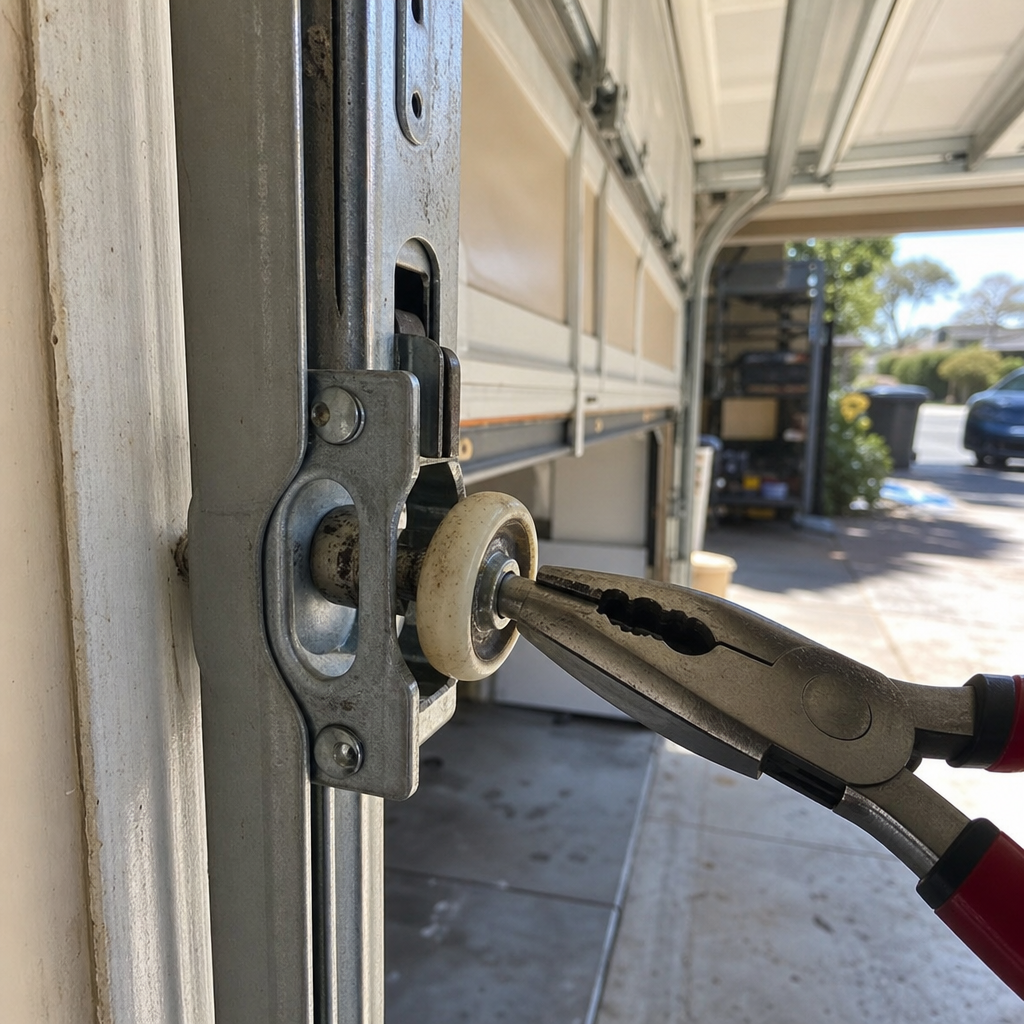
Call a professional immediately if your garage door won’t close and the gap leaves your home exposed — this is a security issue, not just a mechanical one. Call if a torsion spring has snapped; the loud bang and the door suddenly feeling like it weighs 400 pounds are the telltale signs, and a broken torsion spring is not a DIY repair under any circumstances. Call if cables have jumped the drum or are visibly frayed — a cable under tension can cause serious injury if it releases unexpectedly. Call if your opener is running but the door isn’t moving, which often signals a stripped gear set or a disconnect that needs professional diagnosis before something more expensive breaks.
For any of these situations in Pacific Palisades, Precision Overhead Door Service Pacific Palisades offers free estimates and emergency service — call (866) 650-8772 and you’ll speak with someone who can assess the situation and get a time on the schedule.
Frequently Asked Questions
How much does garage door repair cost in Pacific Palisades?
Most garage door repairs in Pacific Palisades run between $120 and $450 depending on the component and the labor involved. A single torsion spring replacement typically falls in the $150–$325 range; cable replacement runs $95–$175; opener repairs vary widely by brand and failure type, with a full opener replacement on a LiftMaster or Chamberlain unit ranging from $350–$700 installed. These are Pacific Palisades market ranges — coastal California pricing reflects parts availability and technician labor rates in this area specifically.
Do I need a licensed contractor for garage door repair in California?
Yes — any repair or installation exceeding $500 in combined labor and materials requires a CSLB-licensed contractor in California. Given that most non-trivial garage door work hits that threshold, you should always verify an active license before hiring. Unlicensed work can void your homeowner’s insurance coverage for the repair and leaves you with no recourse if the work fails or causes property damage.
What’s the difference between a garage door repair company and a general handyman?
A garage door specialist works exclusively on one system — they’ve seen every failure mode on every major brand and know the diagnostic shortcuts that come only with repetition. A generalist handyman can handle many home repairs competently, but garage door systems involve high-tension components (springs store enormous mechanical energy) where misdiagnosis or incorrect installation creates safety risk. For anything beyond a simple panel scuff or a remote battery, use a specialist.
How do I know if a garage door contractor is legitimate in Pacific Palisades?
Verify their CSLB license number at cslb.ca.gov, confirm they carry liability insurance, ask for a written estimate before any work begins, and ask directly who will be physically on the job site. Legitimate contractors answer all of these questions without hesitation. Any resistance to written documentation or license verification is a clear signal to stop.
Why do garage doors fail more often in coastal neighborhoods like Pacific Palisades?
Salt air from the Pacific accelerates oxidation on steel components — springs, cables, tracks, and roller axles. Homes in Pacific Palisades, particularly those west of Sunset and along the bluffs, see hardware corrosion that happens significantly faster than inland properties. This is why proper spring selection matters: a coastal installation should use galvanized or powder-coated springs rated for the environment, not standard oil-tempered springs that will rust and weaken ahead of their cycle-count rating.
What should a garage door warranty cover?
A complete warranty covers three things separately: the parts (the specific component, by name, for a defined period), the labor (the installation work itself, typically 30–90 days minimum from a legitimate operator), and the manufacturer’s warranty on brand-name components like LiftMaster or Genie openers — which the technician should help you register at installation. If a contractor offers a single vague “one-year warranty” without distinguishing between these three, ask them to clarify exactly what fails and what the process is to make a claim.
The Bottom Line
Hiring a garage door contractor in Pacific Palisades isn’t complicated, but it does require a few specific steps that most people skip. Verify the CSLB license, not just the Google rating. Ask who’s physically coming to your home before you book. Get everything in writing before the first bolt is touched. Understand what your warranty actually covers versus what it sounds like it covers. And recognize that the lowest advertised price is almost never the final price — in a market like the Palisades, the goal of predatory operators isn’t to win on value; it’s to get through your door.
Steven Moore has been doing this work in Pacific Palisades for 12 years. His name is on the business and he’s typically the one on the job. That kind of direct accountability is harder to find than it should be — and it’s the thing worth looking for first.
If you need Garage Door Repair in Santa Monica or the surrounding Westside, or you’re exploring a full Garage Door Installation in Santa Monica, or need a new Garage Door Opener in Santa Monica, Precision Overhead Door Service covers the full corridor. Call (866) 650-8772 for a free estimate — no obligation, no pressure, and a straight answer about what your door actually needs.
Written by the team at Precision Overhead Door Service Pacific Palisades, serving Pacific Palisades since 2014.