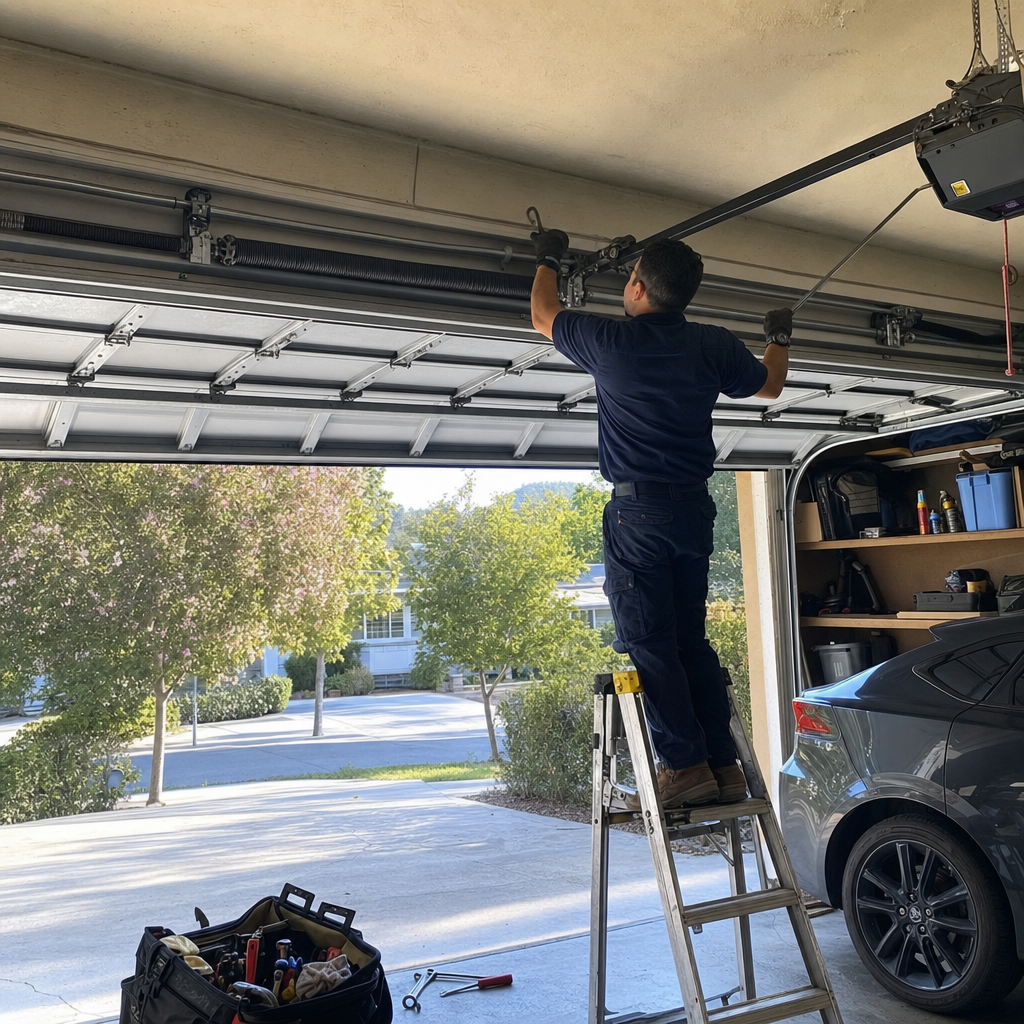
Last updated June 24, 2026
Seasonal Garage Door Care for Pacific Palisades: Year-Round Homeowner’s Guide
Most garage door maintenance guides are written for homeowners in Ohio or Minnesota — places where “winterizing” actually means something. If you live in Pacific Palisades, that template is nearly useless. The threats here aren’t snowpack and frozen springs. They’re marine layer humidity that quietly eats through ferrous hardware from May through July, Santa Ana winds that drive fine ash and debris into every hinge and roller, and coastal UV radiation that degrades painted surfaces faster than almost anywhere else in the country. This guide replaces the generic seasonal checklist with one that maps to what actually happens on the Westside — and what to do about it before it costs you.
Quick Answer
Seasonal garage door maintenance in Pacific Palisades means addressing four distinct climate-driven stress periods: marine humidity from May through July, thermal expansion during the late-summer heat, Santa Ana wind and fire-ash debris in fall, and rain intrusion during winter wet months. Unlike most of the country, the biggest threats here are corrosion, UV degradation, and debris infiltration — not cold-weather contraction. A quarterly inspection schedule tuned to these local conditions will keep your door running reliably and prevent hardware failures that typically cost $200–$600 to repair.
Table of Contents
- May–July: Marine Layer Humidity and Rust Prevention
- August–September: Heat, Thermal Expansion, and Opener Calibration
- October–November: Santa Ana Winds, Ash Debris, and Cable Stress
- December–February: Rain Intrusion, Threshold Seals, and Drainage
- Year-Round: UV Degradation on Painted and Composite Doors
- Monthly Maintenance Checklist for Pacific Palisades Homeowners
- Common Mistakes to Avoid
- When to Call a Professional
- Frequently Asked Questions
- The Bottom Line
May–July: Marine Layer Humidity and Rust Prevention
June Gloom is a Pacific Palisades fixture — and while locals joke about the overcast mornings, garage door hardware does not find it funny. The marine layer that rolls in off the Santa Monica Bay between May and mid-July brings sustained relative humidity that regularly sits above 85% during overnight and early-morning hours. That’s the environment where rust formation on exposed ferrous hardware — springs, hinges, cable drums, and track bolts — accelerates significantly. We’ve seen torsion springs on doors installed only three years ago show surface oxidation during this window simply because they were never treated after installation.
The right lubricant for this period matters more than most homeowners realize. Standard WD-40 is a solvent, not a lubricant — it displaces moisture temporarily but leaves hardware dry and unprotected. What actually works in a coastal high-humidity environment is a white lithium grease or a silicone-based spray applied to hinges, rollers, and the full length of the torsion spring. These products leave a protective film that doesn’t attract the fine grit and particulate that comes off the hills and from nearby Topanga Canyon road dust. Avoid petroleum-based heavy greases during this period — they trap debris and turn abrasive inside roller bearings within weeks.
Marine-season hardware checklist (late May, repeat in early July):
- Inspect torsion or extension springs for surface rust or pitting — early rust is orange surface staining; late rust creates visible pits and scale
- Apply white lithium grease or silicone spray to all hinges and roller stems (not the nylon roller wheel itself)
- Wipe cable drums with a dry cloth before applying a light silicone mist — salt-air particulate accumulates on the cable grooves
- Check all exposed track hardware fasteners for corrosion — zinc-plated hardware on older Wayne Dalton and Raynor systems is especially vulnerable
- Inspect the bottom section’s interior face for moisture wicking — wood-core doors, including many Clopay and Amarr raised-panel designs, absorb humidity through the bottom rail if the weatherseal is failing
August–September: Heat, Thermal Expansion, and Opener Calibration
Late summer in Pacific Palisades — particularly in the Castellammare and Upper Riviera sections that sit further from the immediate coast — can push sustained afternoon temperatures into the low-to-mid 90s°F. That’s enough to cause measurable thermal expansion in both aluminum and steel door panels, and it creates a specific problem that most homeowners misdiagnose: the opener stops mid-travel, reverses unexpectedly, or strains audibly when it never did before in spring.
What’s happening is straightforward physics. Steel door panels expand in the heat, and that expansion changes the door’s effective height by as much as a quarter inch on a full 16-foot wide door. If your opener’s travel limits were calibrated during cooler months, the door may now be overrunning its down-limit or binding slightly in the tracks before the opener registers resistance. LiftMaster and Chamberlain belt-drive openers with smart travel technology can compensate for minor drift, but older chain-drive units and many Craftsman models will need manual limit adjustment after a sustained heat period.
How to check your opener’s travel limits after summer heat (applies to most belt and chain-drive models):
- Operate the door through three full open-and-close cycles and watch for hesitation, grinding, or reversal near the fully-closed position
- With the door fully closed, check that the bottom seal compresses evenly across the full width — uneven compression often means thermal warping rather than a travel-limit issue
- Locate your opener’s limit adjustment screws (typically labeled “UP” and “DOWN” on the motor housing — consult your LiftMaster, Genie, or Chamberlain manual for the exact location)
- Make adjustments in small increments — no more than one full turn at a time — testing after each adjustment
- If the door runs smoothly but the opener motor sounds strained, check the spring balance: disconnect the opener and manually lift the door — it should rise smoothly with one hand and stay at the halfway position unsupported
Track alignment is also worth checking this time of year. The brackets attaching vertical tracks to the wall framing can loosen as the structure expands and contracts, and a quarter-inch of lateral play in a Pacific Palisades home’s track system translates to roller wear and noise that compounds quickly.
October–November: Santa Ana Winds, Ash Debris, and Cable Stress
The Santa Ana wind events that sweep through the Palisades each fall create two distinct problems for garage doors. The first is the direct mechanical stress: sustained gusts above 40 mph and peaks well above that put lateral load on an 8-foot-tall door that the cable system isn’t designed to absorb while the door is in the raised position. We’ve seen cable anchor bracket fasteners pull partially out of deteriorating wood framing on homes near Sunset Mesa after particularly severe Santa Ana events — not catastrophic failures, but the kind of progressive loosening that eventually snaps a cable under normal use.
The second problem is subtler and more damaging over time: fine ash and debris from brushfires — whether from distant events or the closer fires that have historically affected the hills above Pacific Palisades — work their way into roller bearings and hinge knuckles as a dry abrasive. This material is finer than road grit and doesn’t flush out the way rain-carried dirt does. It embeds in the lubricant film, turns it into a lapping compound, and accelerates wear on nylon rollers and bearing races in ways that aren’t visible until the hardware fails.
Post-Santa Ana inspection and cleaning steps:
- Wipe all hinges, roller stems, and cable drums with a dry microfiber cloth before applying any lubricant — lubricating over ash debris locks it in place
- Use compressed air (a standard workshop compressor or even a can of compressed air) to blow out roller bearing housings before re-lubricating
- Inspect the track channels — ash settles in the bottom of the vertical and horizontal track curves; a folded dry cloth drawn through the track removes it effectively
- Check cable tension on both sides for evenness — hold the door at the midpoint by hand and feel for any sideways lean, which indicates unequal cable tension
- Look at the bottom corners of the door for bent cable brackets, which take the lateral shock load during high-wind cycling
- Inspect bottom weatherseal for tears — Santa Ana-driven debris shreds vinyl seals faster than almost any other condition
December–February: Rain Intrusion, Threshold Seals, and Drainage
Pacific Palisades doesn’t get a lot of rain — typically 12 to 15 inches annually — but when it does rain, it tends to come in concentrated storms. The real garage door problem during the December-through-February window isn’t the rain itself; it’s the way driveway drainage geometry lets water pool at the base of the door and sit there.
Many driveways in the lower Palisades, particularly in the Alphabet Streets neighborhood and along Via de la Paz, have a neutral or slightly negative slope toward the garage — a grading situation that was acceptable under older drainage assumptions but becomes a problem in heavy rain years. Water pools at the threshold, wicks under the bottom seal, and saturates the bottom panel of the door. On wood-core doors, that means delamination of the exterior skin. On steel doors, it means rust from the inside out — harder to see and faster to progress than surface rust.
The fix is two-part. First, the threshold seal: a rubber or vinyl threshold dam bonded to the garage floor creates a positive barrier that a simple bottom weatherseal can’t provide on its own. Second, the bottom weatherseal itself: the standard blade-style seal that comes factory-installed on most Clopay, Amarr, and Wayne Dalton doors is adequate for modest weather but degrades quickly and needs inspection every 12 to 18 months in a wet-season climate.
Winter rain-season inspection list:
- Check the threshold seal for gaps, tears, or sections that have lifted from the floor — even a one-inch gap lets in significant water during a heavy event
- Run a garden hose along the full base of the closed door and inspect the interior floor for any water intrusion
- Look at the bottom two inches of the door’s interior face for water staining, bubbling paint, or soft spots (wood core)
- Inspect the bottom section’s exterior skin at the bottom rail — rusting from the fold-over edge inward is a telltale sign of chronic pooling
- Check both side weatherseals (jamb seals) for compression — they should make full contact with the doorstop trim when the door is closed
- Verify that any floor drain in the garage is clear — a clogged floor drain turns a manageable intrusion into a flooded garage
Year-Round: UV Degradation on Painted and Composite Doors
Pacific Palisades sits at roughly 34 degrees north latitude with a coastal orientation that maximizes southern and western sun exposure. The UV index here regularly reaches 8 or above between April and October — categorized as “very high” — and south- and west-facing garage doors take that exposure directly. For painted wood doors and composite overlay doors (common in the custom homes along Amalfi Drive andNapoli Drive), UV degradation is a year-round process that accelerates noticeably in summer.
What UV actually does to a painted garage door: it breaks down the binder in the paint film, causing chalking first (a powdery surface residue), then micro-cracking, then delamination where the paint separates from the substrate. On a real wood door — even a high-quality custom mahogany or cedar door — delamination of an exterior finish in a coastal UV environment can begin within three to four years of the last recoat if the wrong product was used or the surface wasn’t properly prepared.
UV protection and recoat schedule for Pacific Palisades conditions:
- Real wood doors: Inspect the finish annually in October (after summer UV peak). Full recoat every 3–4 years using an exterior alkyd or 100% acrylic paint with UV inhibitors; stained doors may need reapplication every 2 years
- Composite overlay doors (Clopay Grand Illusion, Amarr Carriage House): Inspect for micro-cracking at panel seams; repaint with elastomeric exterior paint every 5–6 years
- Painted steel doors: Watch for chalking at panel face centers; wash with mild detergent and water annually; touch-up chips immediately — bare steel in a coastal environment rusts within weeks
- Between recoats: A quality automotive UV protectant applied to clean painted panels twice a year (spring and fall) measurably extends finish life
- Never power-wash a wood or composite door — the water penetration accelerates the moisture cycling that causes delamination
Monthly Maintenance Checklist for Pacific Palisades Homeowners
Beyond the season-specific work above, a brief monthly check takes less than ten minutes and catches small problems before they become expensive ones. The goal isn’t to over-maintain a door — it’s to spot the early indicators that the seasonal stresses above are creating hardware wear.
Monthly visual and operational check — 10 minutes:
- Listen during operation: Run the door up and down once. New grinding, squeaking, or thumping indicates something has changed — a roller bearing beginning to fail, a hinge pin that’s dry, or a track section that’s shifted
- Watch the movement: The door should rise and lower without jerkiness or lateral sway. Any hesitation in the first 12 inches of travel is often a spring balance issue
- Check the auto-reverse: Place a 2×4 flat on the ground under the center of the door and close it. The door should reverse within two seconds of contact. If it doesn’t, the opener’s force sensitivity needs adjustment immediately — this is a safety requirement
- Look at the springs: From a safe distance, inspect torsion springs (above the door) for visible rust or a gap in the coils that wasn’t there before. A gap means a spring has broken — do not operate the door manually
- Check the bottom seal: A quick look from inside the closed garage — can you see daylight along any section of the bottom? Any gap is letting in pests, moisture, and debris
- Test the manual release: Pull the red release cord once to confirm it disengages smoothly. In an emergency — or after the power goes out during a winter storm — you need to know this works without wrestling with it
If you have a LiftMaster or Chamberlain opener with MyQ connectivity, use the app’s activity log monthly to check for any unexpected door cycling — it’s an underused diagnostic tool that catches battery backup issues and accidental remote activations.
Common Mistakes to Avoid
- Lubricating over ash or grit debris after a Santa Ana event. Applying white lithium grease to a hinge that’s coated in fine ash turns the lubricant abrasive. Always wipe and blow out hardware before lubricating — in Pacific Palisades during fire season, this is especially critical.
- Using WD-40 as the primary lubricant. WD-40 is a water displacer and solvent — it’s useful for freeing a seized fastener but leaves hardware essentially dry within days. In the marine-layer humidity window, that means rust accelerates on the very hardware you thought you just protected.
- Ignoring the threshold seal. Many Pacific Palisades homeowners replace the bottom weatherseal and assume they’re done. If your driveway drains toward the door, a bottom seal alone won’t stop pooled water from wicking under the door — you need a threshold dam bonded to the floor.
- Adjusting spring tension yourself. Torsion springs on residential garage doors are under several hundred pounds of torque. We’ve seen DIY spring adjustments result in serious injuries. This is one task that genuinely requires professional tools and training — the cost of a professional spring service is a fraction of an ER visit.
- Skipping opener calibration after summer heat. Homeowners often interpret a straining opener in late summer as a failing motor and replace it unnecessarily. In many cases, the door simply needs travel-limit recalibration after thermal expansion — a 15-minute adjustment, not a $300 opener replacement.
- Power-washing painted wood or composite doors. It feels thorough, but the water pressure forces moisture into seams and panel joints, accelerating exactly the delamination process that UV was already starting. Hand-wash with a soft brush and mild soap.
- Waiting for a full failure before calling for service. A cable that’s fraying, a spring with surface rust pitting, or a roller that clicks on every revolution is giving you advance warning. Addressing these indicators proactively costs $100–$250 in most cases. Waiting for the failure often means a door that won’t open, a car trapped in the garage, and an emergency call on a Saturday morning.
When to Call a Professional
Some maintenance is genuinely appropriate for homeowners to handle — lubricating hinges, inspecting seals, cleaning tracks. But there’s a clear line where DIY stops being helpful and starts being hazardous or counterproductive.
Call a professional when: a torsion or extension spring is broken, rusted through, or has a visible gap in the coils; a cable is frayed, has jumped off its drum, or is hanging loosely; the door moves sideways or binds against the track frame rather than tracking smoothly; the opener’s force settings have been maxed out and the door still won’t travel fully; a panel has been struck and the structural integrity of the door section is compromised; or you’ve made limit adjustments and the door still reverses unexpectedly — at that point the opener’s force calibration needs professional evaluation.
These aren’t judgment calls — they’re situations where the risk of injury or further damage from a DIY attempt is real. Precision Overhead Door Service Pacific Palisades offers free estimates in Pacific Palisades — call (866) 650-8772 to schedule an inspection or get a same-day assessment on an urgent issue.
Frequently Asked Questions
How often should I lubricate my garage door in Pacific Palisades?
In Pacific Palisades, lubricate garage door hinges, roller stems, and torsion springs three times per year — once in late May before the marine layer humidity peaks, once in October after the Santa Ana season, and once in January. The coastal marine layer accelerates oxidation faster than inland climates, so the standard “once a year” advice from generic maintenance guides is genuinely insufficient here.
What’s the best lubricant for garage door hardware in a coastal climate?
White lithium grease and silicone-based sprays are the right choices for coastal Pacific Palisades conditions. White lithium grease is ideal for hinges and cable drums; silicone spray works well on roller stems and the torsion spring coils. Both resist moisture without attracting the fine particulate common in the Palisades. Avoid petroleum-based heavy greases — they trap debris and turn abrasive in roller bearings, particularly during fire season when ash is present.
How do I know if my garage door spring is failing before it breaks?
The most reliable early indicator is balance: disconnect the automatic opener by pulling the release cord and manually lift the door to the halfway position. It should stay there with minimal drift. If it falls, the springs are losing tension and should be inspected professionally. Visible rust, pitting, or a gap in the spring coils are also clear warning signs. In Pacific Palisades, marine-layer exposure means spring corrosion can progress meaningfully in 18–24 months without lubrication.
Why does my garage door struggle or reverse during late summer?
Late-summer opener struggles in Pacific Palisades are most often caused by thermal expansion of the door panels, not a failing motor. Steel and aluminum doors expand measurably in sustained 90°F+ heat, which can cause the door to overrun its calibrated down-limit or bind slightly in the track. Check spring balance first, then adjust the opener’s travel limits per your unit’s manual. LiftMaster and Chamberlain smart openers handle minor drift automatically; older Craftsman and Genie chain-drive units typically need manual recalibration after a heat period.
How do I protect my painted wood garage door from fading and peeling in Pacific Palisades?
Real wood and composite overlay doors in Pacific Palisades need more frequent finish maintenance than manufacturers’ general recommendations because of the area’s elevated UV index and coastal humidity cycling. Plan on a full recoat every 3–4 years for painted wood doors and 2 years for stained wood. Between recoats, apply a UV-inhibiting automotive protectant twice a year and immediately touch up any chips or cracks — bare substrate in a coastal environment absorbs moisture within weeks. Never use a pressure washer, which forces water into panel seams and accelerates delamination.
When should I replace the bottom weatherseal on my garage door?
Replace the bottom weatherseal when you can see daylight under any section of the closed door, when the seal is cracked or brittle, or when it no longer springs back to shape after compression. In Pacific Palisades, a bottom seal typically lasts 3–5 years depending on UV exposure and driveway surface texture. If your driveway has a neutral or inward slope — common in several neighborhoods along Via de la Paz and in the lower Alphabet Streets area — pair the new seal with a rubber threshold dam to prevent pooled rain water from wicking through.
The Bottom Line
Garage door maintenance in Pacific Palisades isn’t hard — but it has to be calibrated to what actually happens here. Marine humidity in late spring, thermal expansion in late summer, fire-ash infiltration in fall, and rain intrusion in winter are the four stress periods that drive real failures on the Westside. A generic maintenance schedule misses all of them. The homeowners who avoid $400–$800 repair bills aren’t doing more maintenance — they’re doing the right maintenance at the right time of year. Work through the seasonal checklists in this guide, watch for the early warning signs in your monthly checks, and address small issues before the Pacific Palisades climate turns them into urgent ones.
When you need professional eyes on a spring, cable, opener, or panel — whether it’s a scheduled inspection or an urgent situation — Steven Moore and the team at Precision Overhead Door Service are the specialists to call. Steven has spent 12 years working exclusively on garage doors, he services all major brands including LiftMaster, Chamberlain, Genie, Clopay, Amarr, Wayne Dalton, Craftsman, and Raynor, and 88 five-star reviews reflect what that kind of focused expertise looks like job after job. Call (866) 650-8772 for a free estimate.
And if your needs extend beyond the Palisades, we cover neighboring communities as well — whether you’re looking for Garage Door Repair in Santa Monica, need Garage Door Installation in Santa Monica, or are shopping for a new Garage Door Opener in Santa Monica, the same specialist expertise and personal accountability follow every job.
Written by the team at Precision Overhead Door Service Pacific Palisades, serving Pacific Palisades since 2014.